SEO for Affiliate Marketing: Top Organic LeadGen Strategies

Long gone are the days when you could generate organic leads by creating keyword-centric content. In 2026, when affiliate marketing is at the peak of momentum, keywords aren’t the answer. You need so much more. Even as a seasoned affiliate with a footing in the game, you need to optimize for user intent and LLMs and use AI without overcommitting to it.
But hard doesn’t mean impossible.
Affiliates with Zero Parallel consistently reach the top of search and LLM results, increasing the number of generated and sold leads in our network. But, of course, they don’t just publish keyword-centric content – they do much more, from laying a strong foundation for future success to staying disciplined along the way until search engine algorithms appreciate their content, not least due to all the SEO affiliate marketing up their sleeve.
So, how do you make SEO work for affiliate marketing in 2026?
The short answer is, do the math in the first place, evaluating whether there’s space for you in a given niche, and then continuously play to your strengths, doubling down on what you can do best and the strategies that work. And measure everything. All the time. Data is king.
Below is your complete guide to SEO affiliate marketing in 2026.
Setting the Right Foundation: Demand, Competition, and Payouts
First things first: to make money with affiliate marketing, you have to advertise a product that is in demand (read: has high search volume).
So you start SEO affiliate marketing by getting a keyword research tool – for example, Ahrefs – and checking the volume for the keywords you’re going to focus on.
Take, for example, “financial services:”
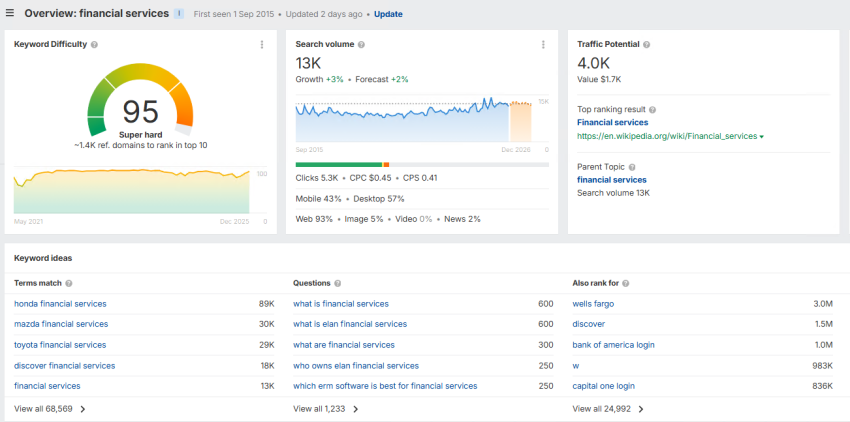
As you can see, the volume is there: 13,000 search queries per month in the United States alone is more than enough to make money with affiliate marketing.
However, there are also some problems with this keyword:
- The competition is tough: 95 out of 100 by Ahrefs means it’s almost impossible to hit the top of SERPs unless you have hundreds of thousands and potentially millions of dollars to build your brand over the years.
- The keyword is generic: More likely than not, the goal of the SEO for affiliate marketing you’re doing is to generate leads or sales, which means you need transactional keywords – for example, “IT support for financial services” – not generic ones with unclear intent and extreme competition.
In our case, you have to either change the keyword or dig deeper into the keyword cluster to find easier transactional keywords you can realistically rank for.
So let’s check the matching terms:
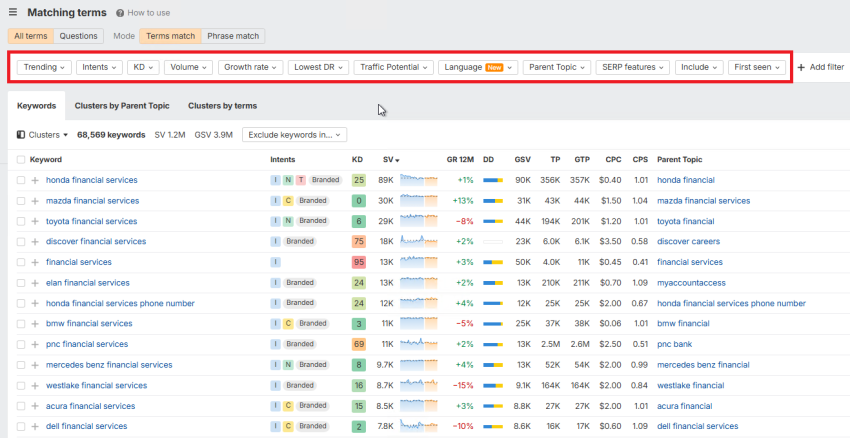
As you can see, most keywords are branded, which means they are associated with a specific company and therefore are irrelevant unless you’re promoting a product of this very company.
The good news is that you can get the keywords you need by applying filters:
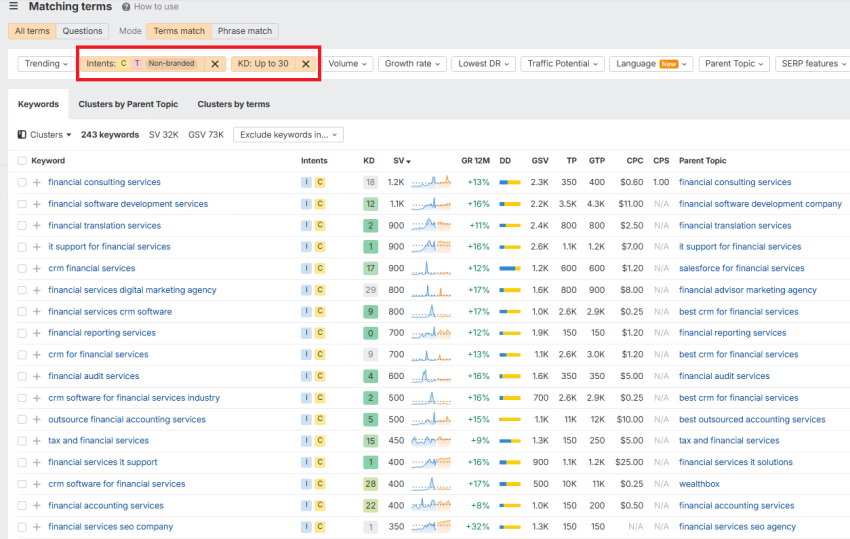
Ahrefs provides dozens of filters, from keyword type to volume to difficulty, and more. Again, if you’re just promoting a product rather than building a long-term marketing funnel, search for transactional and commercial keywords.
Now, let’s say your target keyword is “IT support for financial services.”
If so, type it in Keyword Explorer to get all the marketing metrics:
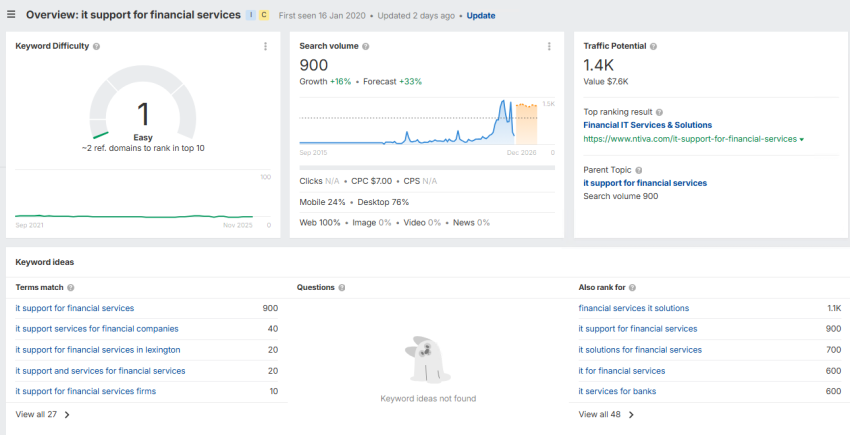
“IT support for financial services” seems to be a great keyword, with clear commercial intent, almost no competition.
But here’s the caveat: Ahrefs calculates keyword difficulty based on the number of links to the page, not factoring in the website’s overall authority. So even for KD =1, real competition can be quite insane.
Here’s what the actual competition is for “IT support for financial services:”
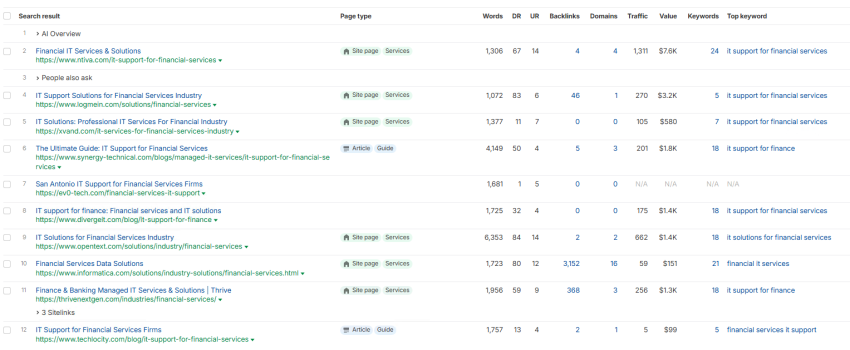
Both high-DR and low-DR brands occupy top spots, with your best chance being displacing those with lower DR and fewer referring domains. But then again, make sure to check every company manually to understand what they are, their content, and whether they are your direct competitors in the first place.
Speaking of which, here’s how you can identify your SEO affiliate marketing competitors:
→ As far as SEO affiliate marketing goes, your real competitors are affiliates, influencers, content creators, and performance marketers (not product companies) of a caliber similar to yours and with comparable resources, and that are doing what you can replicate.
So, for example, Neil Patel isn’t your competitor unless you’re a renowned affiliate marketer with a huge online following and a big website. But there are countless smaller-scale affiliates that you can analyze, including the gaps you can bridge to outrank them and gain organic traffic.
Here Is What You Should Know About Payouts before Starting SEO Affiliate Marketing
As an affiliate marketer, always keep the end goal in mind: monetizing leads, phone calls, or clicks because this directly impacts your SEO strategies.
Here are two basic things to consider before you start with SEO affiliate marketing:
- Choose a profitable affiliate marketing program that offers competitive payouts and, if you’d like to kickstart lead generation, also offers creative assets like lead generation forms
- Calculate how many sales you should make on average to achieve your financial goals, given the average payout
To pave the winning trajectory from the get-go, you need to perform a comprehensive analysis of your goals, capabilities, and market conditions. The quality of this foundational work, by and large, determines the possibility of success. It’s crucial to always be in a favorable environment that allows you to realize your full creative potential while respecting the realities of the market you’re trying to conquer and the principles of SEO affiliate marketing.
In SEO Affiliate Marketing, Bet on Search Intent, not Keywords
Whether you’re developing a long-term content plan or covering topics one at a time, try to understand the search intent behind the query. Filter keywords into informational, navigational, commercial, and transactional, and exclude branded keywords.
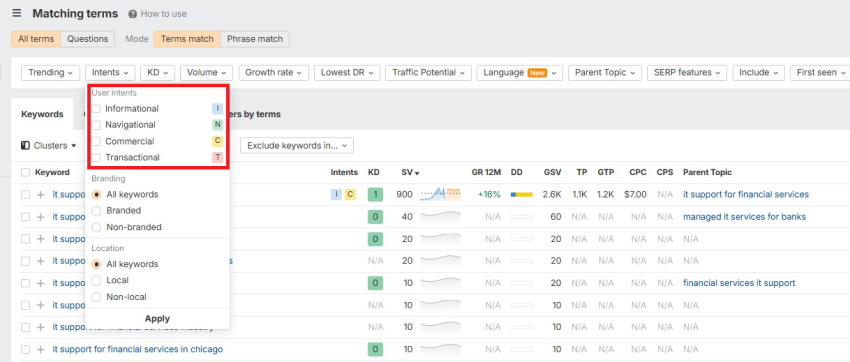
Here’s what users may want to achieve by typing the “credit card” search query:
- General information about how credit cards work
- Compare credit cards to apply for the best one
- Find out whether their credit card fees are higher than average
- Fix bad credit
Identify the intents you’re going to satisfy based on WHY people are using this or that query. Do they just explore, or are they ready to act? You need purchase-ready consumers.
On-Page SEO for Affiliate Marketing
To make SEO for affiliate marketing work, your content should be helpful, well-targeted, unique, and attractive to users and search engines.
And it’s not that hard if you stick with these basic on-page SEO principles:
| SEO Component | Optimization Notes |
| URL Slug | A short, clear URL structure provides clarity for users and helps search engines understand what the webpage is about and where it sits within your website structure. For example, if you compare credit cards, you may go with “/best-credit-cards/“ as the shortest way to clearly indicate the page’s intent while using your core keyword.
Important: URL is arguably the most important part of the webpage because it’s the only element that accumulates authority, backlinks, and behavioral signals. Every time you’re changing URL, you’re effectively creating a new page in Google’s eyes, and even the 301 redirect doesn’t fix the problem completely (you’ll likely still sustain losses). This is why it’s crucial to avoid using long URL slugs, dates, and stop words in URLs, and to ensure the URLs you’re using are evergreen. For example, if you change a URL from best-credit-cards-2025 to best-credit-cards-2026, you are throwing away accumulated authority, trust signals, and rankings with every such change. |
| Meta Title | The meta title is what usually appears in SERPs when users find your content; for example, “Best Credit Cards (2025) – Compare Rewards & Fees.”
The title tag offers a bit more flexibility than the URL, with the general idea being to start it with the page’s main keyword and add intent modifiers that convey the gist of the content. Note that if the title is too long, poorly written, or isn’t perceived as worthwhile by Google for any other reason, it can be automatically replaced with H1, anchor text from links, or just a shorter and clearer version of the original title. |
| Meta Description | The consensus is that the meta description isn’t a ranking factor, so it’s more reasonable to use it as a CTA amplifier rather than as a place to include keywords (you can do both, though). Here’s the example: Compare the 15 top credit cards by APR, cashback, and approval odds to make an informed choice. Updated daily.
Depending on the content, you might want to reinforce the meta description with numbers, trust and risk-reduction factors, and a positive outcome of the intended action for the consumer – all within 160 characters for better viewability. |
| H1 | H1 doesn’t really do much other than confirming the promise of your meta title. Think about H1 as follows: What would be the best first thing a consumer sees on your webpage after they come from a search page? In most cases, H1 should be of exactly the same intent as the title, yet a different wording, including your main keyword or its variations. For example: Best Credit Cards in the USA (2025 Comparison). |
| Page structure | The page structure depends on the type of content, but it’s generally advised to use subheadings (H2 to H4), bullet lists, graphics, interactive elements, and, within reasonable limits, anything that helps keep the reader engaged and improves clarity. Well-structured content usually ranks better and accumulates positive engagement and trust signals over time. |
| FAQ | Having the FAQ section at the end of the page isn’t always necessary, but it can help resolve the intent gaps by answering unanswered questions, providing supporting information, and also as content for the FAQ schema. |
| Links | Internal and external links are essential to support the data on the page, make the content look data-driven, and increase overall trust and readability. The idea is to use internal links to guide users from informational to commercial to transactional intent and to make it easier for crawlers to navigate your pages. |
How fast your website loads is also extremely important. It’s no secret that human attention span decreases, so you may only have a second or two to hook them – and then they’ll leave, not willing to wait or thinking your website is broken or not competitive.
There are quite a few free website speed checkers, with the most popular being PageSpeed Insights, which allows you to check mobile and desktop website speed and identify what slows your site down.
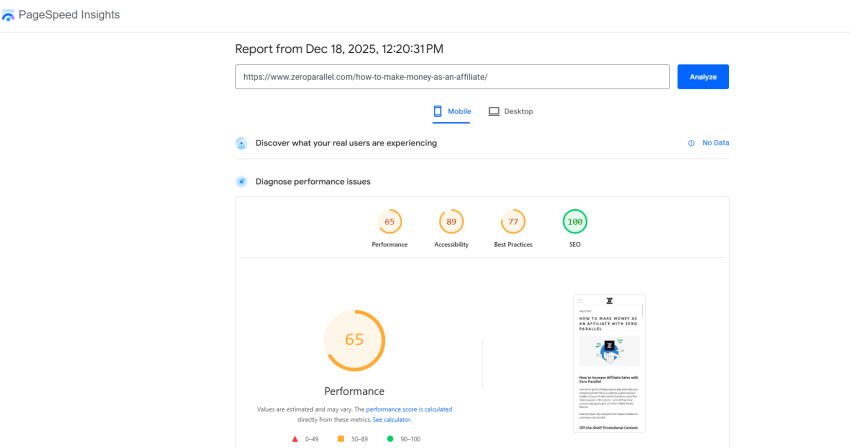
The other underestimated quality signal is freshness, especially in industries like finance, where rates and conditions constantly change.
To keep your pages fresh, integrate dynamic content blocks with rates, prices, availability, rankings, best order, dates, etc., by pulling data from a reliable source via an API. Also, it would help to add a “last updated” note so users instantly see that your content is fresh – even before they discover your dynamic content blocks.
Last but not least, use schema markup to help Google better understand your page content. In the context of SEO affiliate marketing, schema indicates which products are being compared, which reviews exist, and which questions are answered, reducing confusion and misclassification.
Backlinks
Everyone knows many backlinks are either paid or exchanged, but you still need them. Get as many high-quality backlinks as you can while not losing the organic vibe.
A way to approach backlink building is to develop a comprehensive backlinking plan based on your opportunities, budget, and the number of backlinks you need to rank high for the target queries. Prioritize links that you can get naturally, including no-follow links that can potentially bring traffic to your website. For the purpose of SEO affiliate marketing, though, to improve rankings, you should make sure the backlinks you build are do-follow.
Here’s the shortest way to estimate backlink competition in Ahrefs:
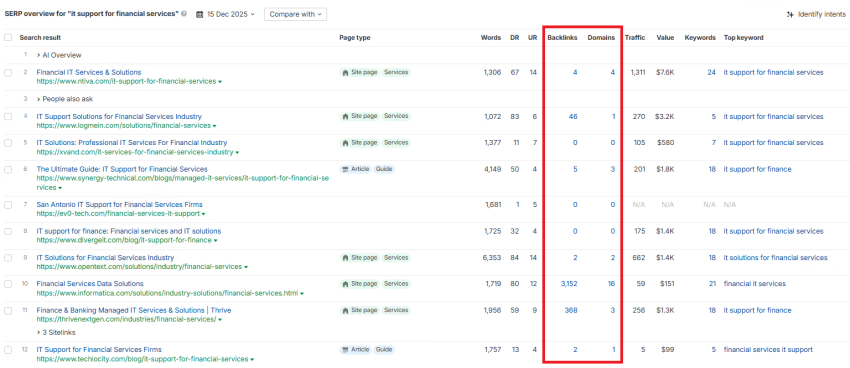
Backlinking strategies for different companies vary drastically. In the top-10, there are three companies with no backlinks at all, and one with over 3,000 backlinks, showing how complex the ranking algorithms are and how many factors are involved. So again, much is about the right distribution of resources and effort – focus on what can potentially deliver higher ROI.
How To Get Backlinks for Free to Supercharge Your SEO for Affiliate Marketing
| Passive Backlinks | Active Backlinks |
|
|
Amassing a large backlink profile surely takes time, even if you have a budget for it – months and years, not even weeks – but it’s so much simpler when you create valuable content and actually have something to say and share with the world.
So again, it all comes down to playing to your strengths and finding that sweet spot that lets you do what you love at scale without ever hitting writer’s block. Whether blogs, videos, podcasts, or else, you need to believe in what you do to sustain your efforts over months and years.
Omnichannel Coverage
Securing your first conversions is a big deal: it motivates you to keep going and likely double down on your first successful traffic channel, whether it’s your website, blog, social media page, or something else. But focusing on one traffic source or strategy without having a backup is quite risky – one big update in search engines, and your traffic may plummet, even if you do legitimate SEO.
→ To maximize your SEO potential in affiliate marketing and your revenues, you should create a predictable marketing engine that spans all essential traffic channels, not just one channel that may lose relevance after the next Google update, CPM spikes, or email deliverability issues.
On a similar note, it makes sense to join several affiliate programs at once rather than relying on a single program, even if it offers the highest commissions. At the very least, you need a strategy to switch quickly without losing momentum if the market changes.
Here are a few points to keep in mind in the context of SEO affiliate marketing:
- The customer journey is almost always non-linear. Most consumers switch channels many times before making a purchase: they discover your blog, then check whether you have a YouTube channel, then disengage, and finally return to your website or social media channel. You need all that to maximize your affiliate marketing potential.
- Lack of omnichannel affiliate marketing means you’re helping someone else. Within the last-touch affiliate marketing attribution model – when the affiliate whose link was clicked last before the purchase or the lead generation event gets the full commission – your SEO efforts surely require a strong follow-up so you can convert the lead that you’ve engaged. Otherwise, you’re just nurturing them for some other company or affiliate.
- SEO affiliate marketing isn’t always about direct sales. If you only focus on what ranks well historically – say, the “best X products” types of posts – while disregarding educational content and content that doesn’t sell directly, you may lose momentum over time. As a fully-fledged affiliate marketer, you need to cover all stages of the sales funnel, from awareness to conversion to retention. Otherwise, Google may soon discover that you’re only focused on sales and likely reduce ranking for your content across the board.
In a well-designed funnel, SEO affiliate marketing ignites that initial interest, and then you should convert it into sales over days, weeks, and possibly months of nurturing. For that, you at least need social media exposure and email marketing on top of website and blog content.
Join as an affiliate and start your journey today, or contact us if you have any questions.
Frequently Asked Questions
How much time do I need for SEO for affiliate marketing to work?
SEO is a marathon, not a sprint, taking around 6 months on average to kick in. In other words, it can take from several weeks to several months and sometimes more for your content to reach its peak performance after publishing. On the bright side, the first impressions and clicks will likely come sooner, and evergreen content can generate leads for months and years.
How much can I earn with SEO affiliate marketing?
There’s no limit to the amount of money you can make with SEO as an affiliate marketer, with the actual income depending on hundreds of factors, from the type of product you promote to your affiliate program to the extent to which you realize your organic lead generation potential.
There is some older research that estimates that 4% of affiliates earn over $150,000 annually, around 15% earn up to $50,000, and the majority earn less than $10,000. It goes without saying that the affiliate marketing income has grown substantially, so figures in 2026 would be higher.
Does Zero Parallel help with SEO affiliate marketing?
Absolutely. Not only do we offer some of the highest payouts in the industry – up to $250 per lead – but we also provide affiliates with an advanced lead management system and professional marketing assistance, including SEO and ready-to-use marketing assets.